

The Data Room turns public sustainability data into practical market intelligence for consultants, climate-tech companies and ESG software teams.
Use it to understand buyer requirements, identify market signals, strengthen the business case and support your sales conversations with evidence you can trace to the source.
Every published finding links to its source, states what was reviewed and shows when it was last checked. Explore everything online for free, or download the full files to use in your own research, planning and sales work.
Citation with attribution welcome; any other reuse needs written permission.
Sustainability markets move through regulation, disclosure, customer requirements, funding and internal commitments. The information is public, but it is spread across filings, reports, program pages and corporate websites.
The Data Room brings that evidence together and analyzes it through a commercial lens, so teams selling sustainability solutions can:
See where requirements, commitments and operating changes may be creating a reason to act.
Ground outreach and sales conversations in the pressures organizations are already navigating.
Use sourced facts instead of unsupported market claims.
Start with structured, reviewed information rather than assembling every answer from scratch.
It is the same discipline Upside ESG brings to market analysis, buyer intelligence and every PennyOS build.
Start with the published datasets and maps below. Each resource includes the public findings, source links, scope, methodology and last-reviewed date. Download the full file when you want to filter, compare or use the underlying information in your own work.

A source-based view of 30 leading ESG and carbon reporting vendors found.

An analysis of voluntary climate-risk reports listed on the California Air Resources Board docket found.
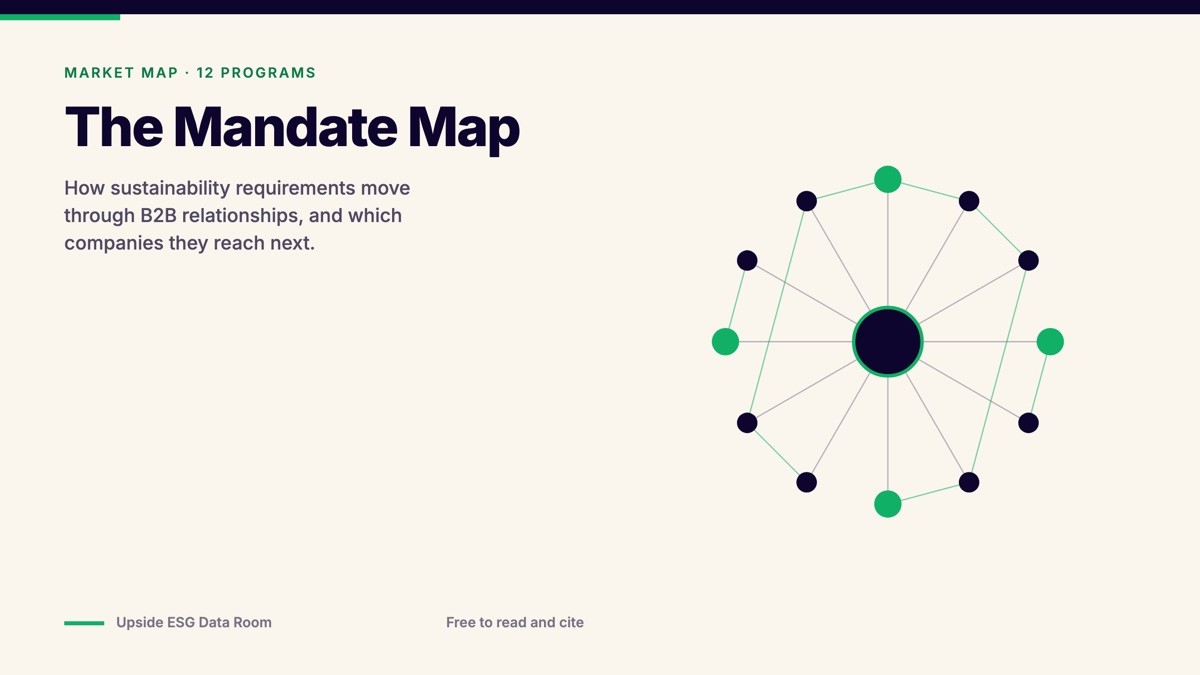
A practical map of 12 programs moving sustainability requirements through B2B relationships found.
The Data Room is designed to make every material claim traceable. Each published resource should include its scope, inclusion criteria, source list, review date and known limitations—not just the finished findings.
Every figure links to a public source wherever one is available. Sources should be cited at the row or claim level so readers can inspect the underlying evidence themselves.
Each resource should explain what was included, what was excluded and how categories were defined. If a judgment was required, the methodology should state the rule used.
Pages show when the resource was last reviewed. Recent review dates help readers judge whether information is still current. We review and update resources periodically.
Data should be checked for consistency before publication. Verified corrections may be incorporated when the relevant resource is next reviewed.
If information is unavailable, ambiguous or not publicly verifiable, say so. “Not publicly found” should not be treated as proof that a policy, target or activity does not exist.

Founder, Upside ESG
The Data Room focuses on the evidence that matters commercially: the mandates creating pressure, the signals that suggest readiness, the gaps a solution may address and the information different members of the buying committee need before they can support an investment.
That same market and buyer intelligence informs Upside ESG's advisory work and the custom PennyOS go-to-market systems built for sustainability solution providers.
New resources are added as the underlying research is completed and checked. Subscribe to Selling Sustainability newsletter to receive new releases.
Who influences, evaluates and approves sustainability purchases—and what each role needs to believe before saying yes.
Sourced statistics for connecting sustainability initiatives to cost, risk, resilience, growth and operational performance, with the source and sample shown for each figure.
What public studies reveal about carbon-accounting adoption, tools, frequency and implementation barriers—with sample details and limitations clearly labeled.
A structured view of what large buyers ask of suppliers, including emissions data, ratings, targets and key deadlines.
New Data Room releases and material updates, delivered by Selling Sustainability.
Unsubscribe at any time. Your information will not be sold.
The Data Room covers questions useful across the sustainability market. Upside ESG also builds custom market, account and buyer intelligence for teams that need to know where to focus, which organizations are showing readiness and how to reach the people behind the budget.
Subscribe to Selling Sustainability. Monthly buyer trends, signals and resources, read by 700+ people at companies like Deloitte, EY, Samsung and more.
Upside Systems operates on the ancestral homeland of the Schaghticoke, Paugussett, and Mohican peoples, who have stewarded this land since time immemorial. We honor their enduring presence and continued connection to this place.